How Does Skin Type Change With Age, Season, and Climate?
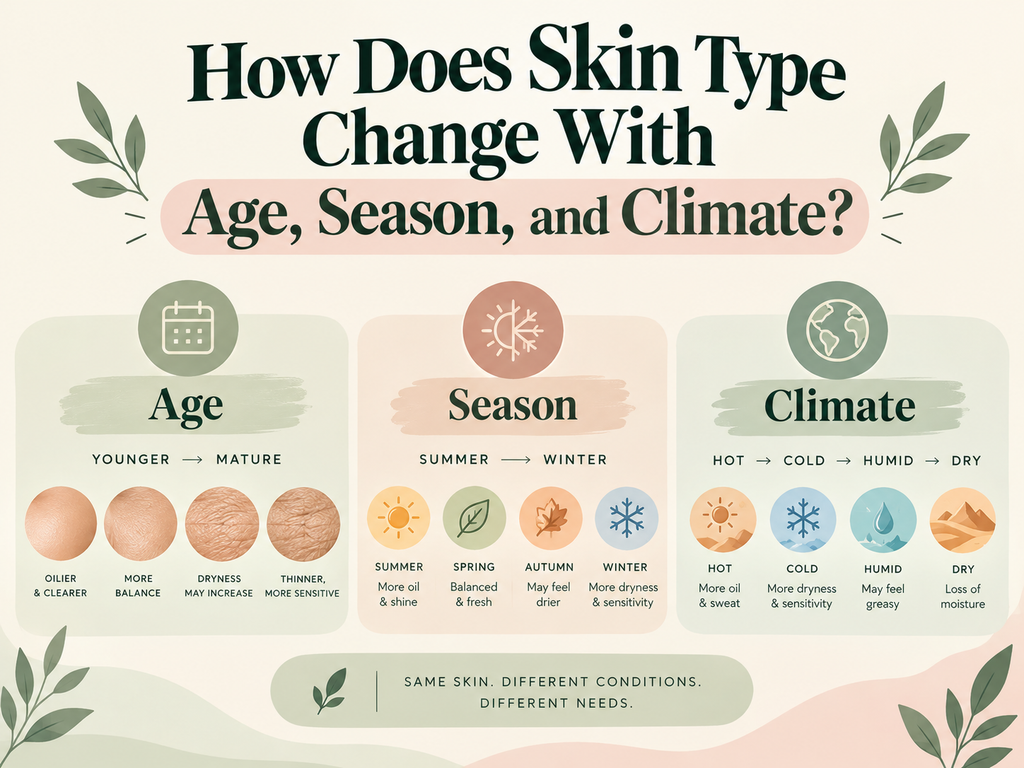
Short answer: Skin can change over a lifetime, mainly because hormones and the skin’s ability to hold moisture shift with age. Most changes you notice from week to week or season to season are temporary responses to weather, indoor air, and routine. They don’t mean you have a new skin type. Age, season, and climate can all influence how your skin feels, but none of them decides your skin type on its own.
Introduction: Why Skin Can Feel Different Over Time
Maybe your forehead looks shiny by noon in July, but your cheeks feel tight and rough by January. Maybe the skin that was oily at 17 feels drier at 50. It is natural to wonder whether your skin type has changed.
Sometimes the underlying pattern has shifted. Often, though, the skin is responding to its surroundings. This article covers three influences:
- Age and biology: hormones, oil production, and moisture retention.
- Seasons: temperature, humidity, sun, and indoor heating or cooling.
- Climate and daily environment: where you live, and the indoor and outdoor air you move through each day.
Knowing which one is at work helps you avoid overreacting to a temporary change, such as buying a whole new routine because of one dry week. It also helps you notice a lasting change that deserves attention.
Can Your Skin Type Actually Change?
It helps to separate four ideas that are often mixed together.
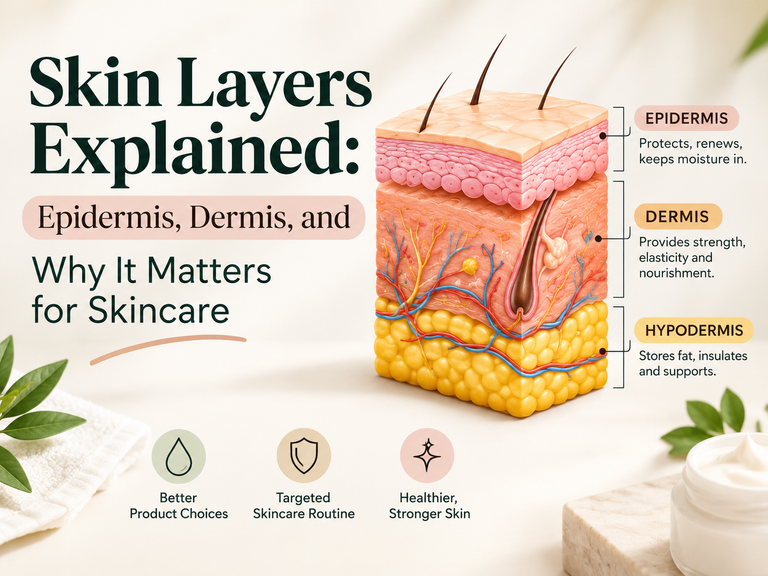
- A relatively persistent pattern of oil production. Your skin’s natural oil is called sebum. It is made by sebaceous glands, which are controlled largely by hormones called androgens. Genetics and hormones influence how much you make. DermNet notes that sebum production is under the control of sex hormones.
- Temporary changes in surface oiliness and moisture. Weather, sweat, sleep, and cleansing habits can change how skin looks and feels on a given day.
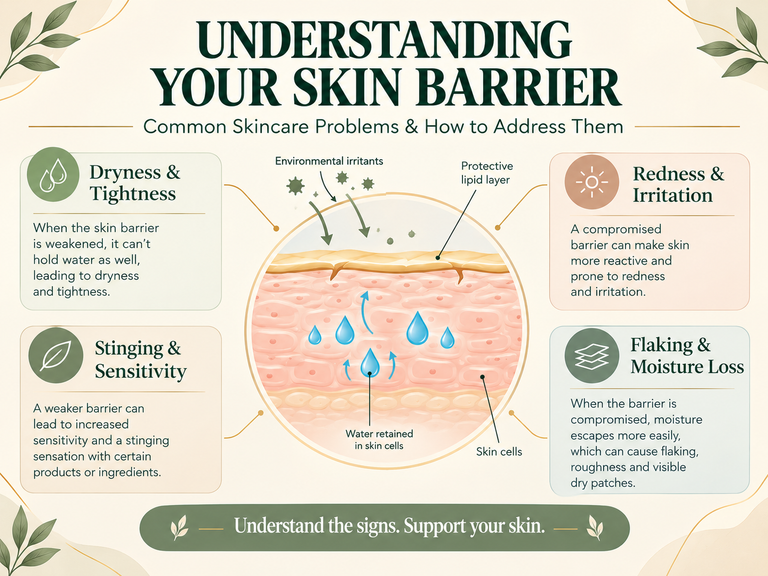
- Skin-barrier disruption and irritation. The skin barrier is the outer protective layer that helps reduce water loss and keep irritants out. When it is stressed, skin can feel tight, rough, or stingy, whatever its oil level is.
- Changes linked to hormones, medications, or health conditions. Menopause, pregnancy, some medications, and some medical conditions can shift how skin behaves.
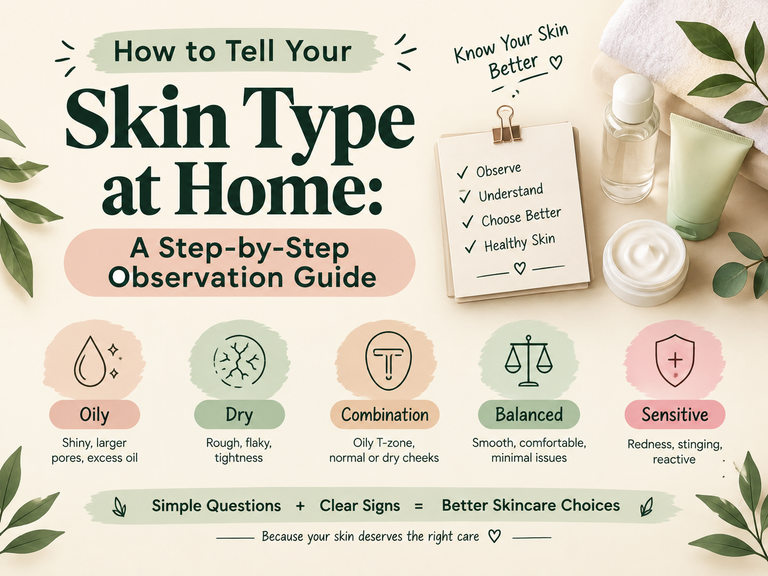
The common categories:
- Oily: often shiny, with visible oil across most of the face.
- Dry: often lower oil, with a rougher or flakier feel.
- Combination: oilier in some areas (often forehead, nose, and chin) and drier in others (often cheeks).
- Balanced (normal): neither strongly oily nor dry.
Sensitive or reactive skin is not a fifth category. It is a separate characteristic that can overlap with any of the four. Someone can have oily, reactive skin or dry, non-reactive skin.
So skin type is neither fixed for life nor guaranteed to change. Some people see a stable pattern for decades, and others see clear shifts after puberty, pregnancy, or menopause.
How Skin Changes With Age
Age-related changes vary a lot between individuals. The patterns below are general trends, not rules.
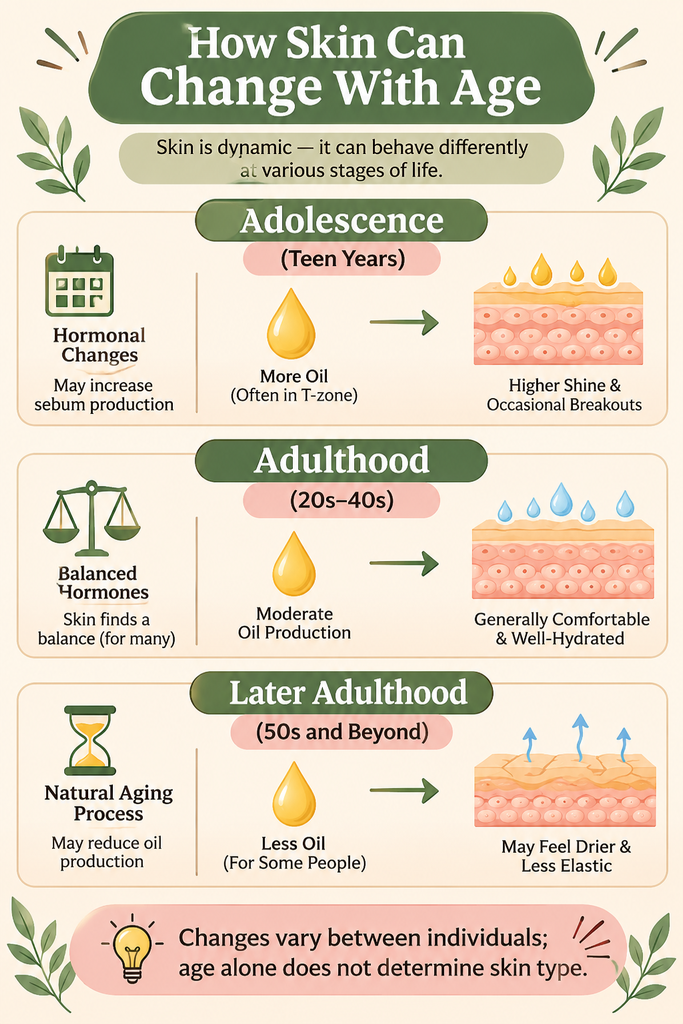
Childhood and Adolescence
Sebaceous glands become much more active at puberty as androgen levels rise. DermNet reports that sebum production can increase up to fivefold in males at puberty. That is why shine and acne are common in the teen years. But not everyone develops oily skin or acne, and the degree varies widely.
Adulthood
In adulthood, skin characteristics depend on hormones, genetics, environment, and habits. Some adults keep an oily T-zone for decades. Others become drier or more sensitive, and others stay about the same. Hormonal events such as the menstrual cycle, pregnancy, and some medications can shift oiliness. Age alone cannot tell you someone’s skin type.
Later Adulthood
Over time, skin tends to change in several ways: the outer layer holds water less effectively, elasticity and thickness change, and surface texture changes. A review of aging and the skin barrier notes that sebum production declines with age, especially after menopause in women, and that men often see little decline until much later. A recent study of adults predisposed to atopic dermatitis found that older age correlated with more dryness and lower hydration, though that was a specific group and not everyone.
Findings are not uniform. A 1991 study of barrier measures across body sites found no significant group differences in sebum, capacitance, or pH at most sites it measured. Aging effects can differ by body area and by person. They also depend on sun exposure over a lifetime.
Age-Related Dryness Versus Dehydration
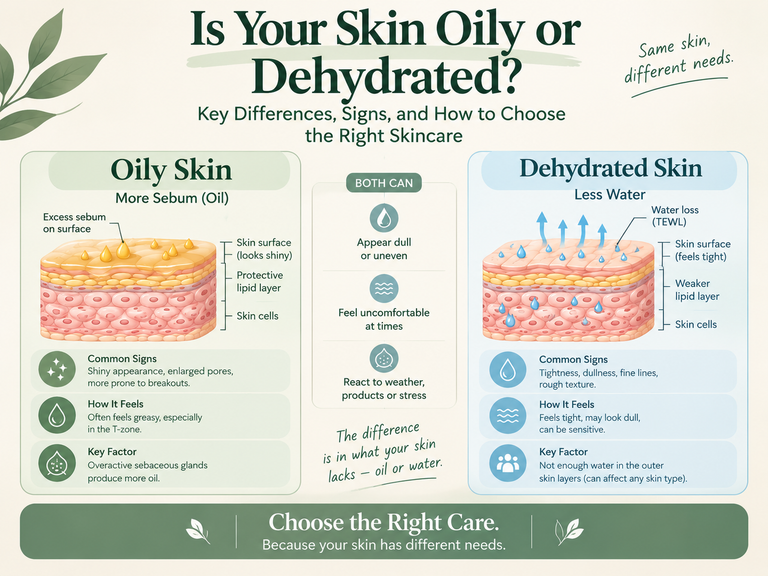
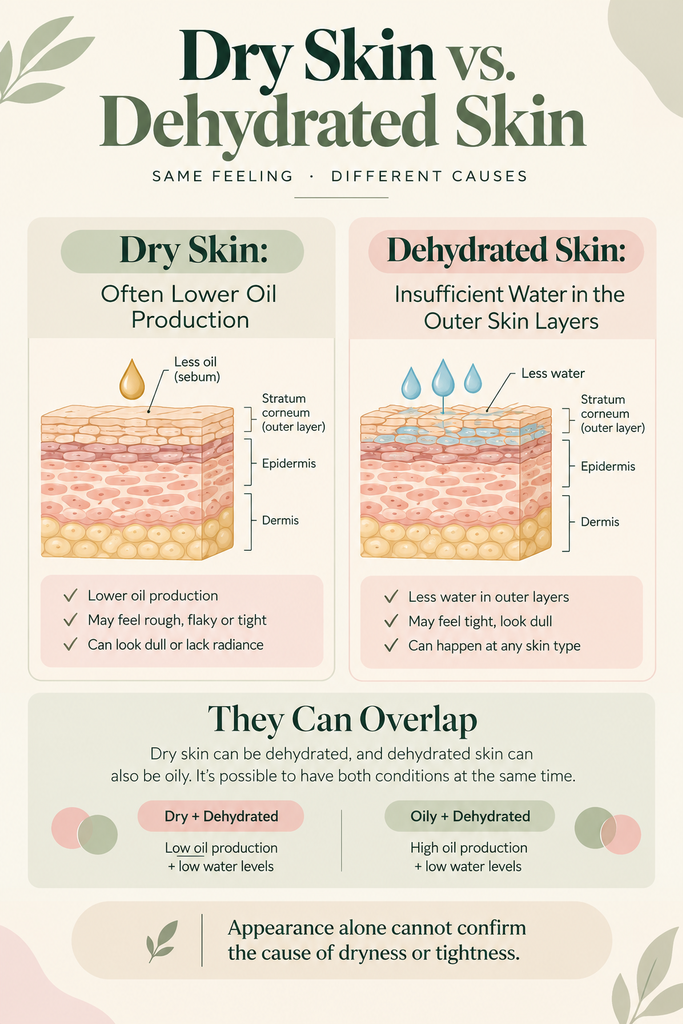
These two can overlap. Dry skin usually refers to lower oil. Dehydrated skin means the outer layers are low in water. Lower oil, reduced moisture retention, environmental exposure, and irritation can all produce similar tightness and roughness.
| Observation | Possible age-related influence | Other possible explanations |
| Skin feels tighter than it used to | Reduced oil and moisture retention over time | Dry indoor air, hot showers, harsh cleansers |
| Rough or flaky patches | Slower, less efficient barrier function | Over-exfoliation, winter weather, irritation |
| Less shine than before | Lower sebum production, especially after menopause | Seasonal change, new products, hormonal shifts |
| New itching or sensitivity | Barrier changes with age | Contact irritation, allergy, eczema |
| Sudden, major change | Less likely to be age alone | Medication, health condition, new product |
Key takeaway: Age can make dryness more likely, but it is rarely the only explanation. A sudden or significant change deserves a closer look at other causes.
How Seasons Affect Skin
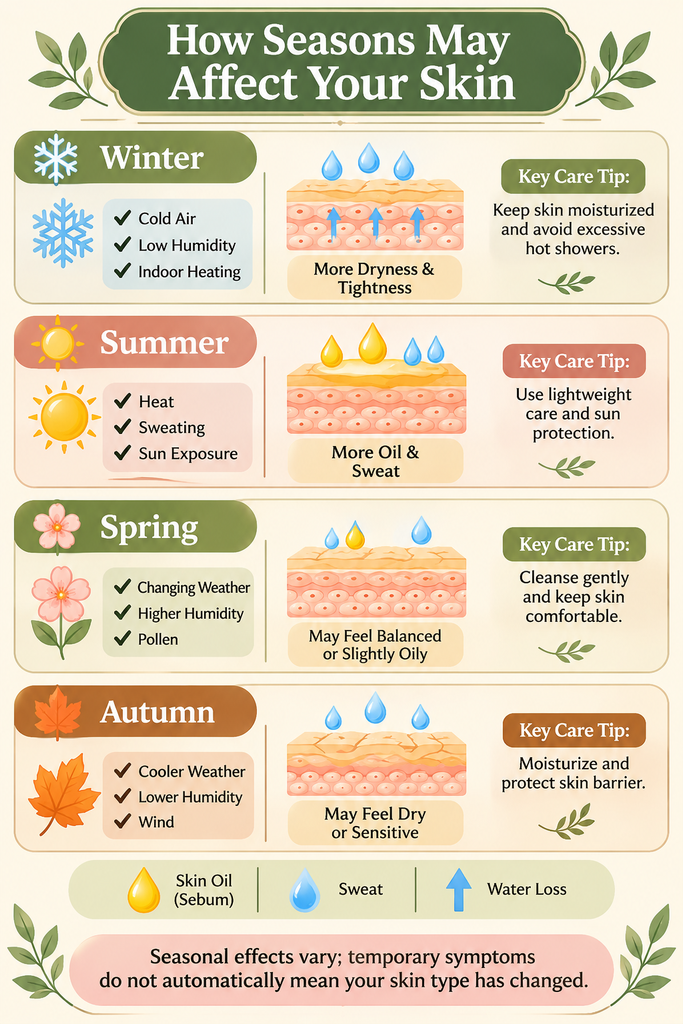
Winter
Cold outdoor air holds little moisture, and indoor heating dries the air further. Hot showers can also strip skin oils. The American Academy of Dermatology (AAD) lists cold, dry air, low humidity from indoor heating, and hot showers and baths as factors that take moisture from skin in winter. Research reviews agree that low humidity and low temperatures reduce skin barrier function on average.
A Danish study of 80 healthy adults found that natural moisturizing factor levels on the cheek were lower in winter than summer. Interestingly, the pattern on the hands was different. Seasonal effects differ by body area.
This is why oily skin in winter can feel tight and dull. The oil is still there, but the outer layers may be short on water.
Summer
Heat, sweat, sun exposure, and changes in daily habits can make skin look shinier or feel different. Sweat and sebum are different. Sweat is mostly water and salts from sweat glands. Sebum is an oil from sebaceous glands. A damp, shiny face in heat may be sweat, not extra oil production.
Some people also notice dry skin in summer. Air conditioning, sun exposure, swimming, and frequent washing can all dry the skin even when the weather is warm. Sunscreen use is also worth keeping in mind. Many dermatology organizations advise broad-spectrum protection, and you should check the current guidance from the AAD or your local health authority.
Spring and Autumn
These transitional seasons bring changing temperatures, humidity, wind, and routines. Skin may need a while to settle. That does not mean these seasons automatically cause sensitivity or allergies. Many people notice nothing at all.
Why Seasonal Changes Don’t Necessarily Mean a Permanent Change
A person can have more shine in humid months and more tightness in dry months while keeping the same general tendencies. If skin returns to its usual behavior when conditions return to normal, the change was probably environmental.
| Season | Common influences | What to observe |
| Winter | Cold air, low humidity, indoor heating, hot showers | Tightness, roughness, flaking, stinging |
| Summer | Heat, sweat, sun, air conditioning | Surface shine, sweat versus oil, dryness indoors |
| Spring | Changing temperature and humidity, wind | Gradual comfort changes |
| Autumn | Falling humidity, early heating | Early tightness or roughness |
Key takeaway: Note the conditions when a change happens. A pattern that follows the season is a good clue that the cause is environmental.
How Climate and Humidity Affect Skin
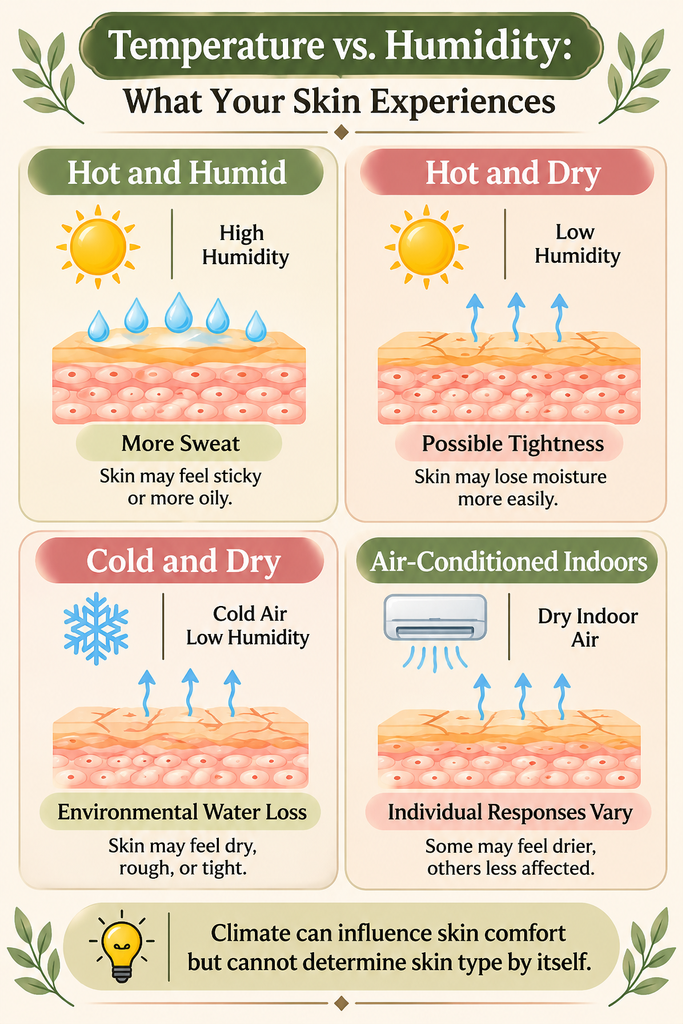
Humidity and temperature are related but not the same. Temperature is how hot or cold the air is. Humidity is how much water vapour the air holds. A cold day can be very dry or damp, and a hot day can be dry or humid. Skin responds to both.
Low humidity and the skin. Laboratory and clinical research shows that low humidity can affect the skin barrier. In a lab model of human epidermis, one hour of low-humidity air increased water loss and weakened barrier markers. Earlier animal research found that prolonged low humidity increased skin cell proliferation and markers of inflammation. These studies don’t prove exactly what happens in every person’s skin, but they support why dry air so often leaves skin feeling tight and rough.
Important limits:
- A humid climate does not automatically mean you have oily skin.
- A dry climate does not automatically mean you have naturally dry skin.
- Climate alone cannot diagnose a skin type.
| Environmental condition | What someone may notice | Important limitation |
| Hot and humid | More sweat, shine, a sticky feeling | Sweat is not the same as sebum; humidity can also ease tightness. |
| Hot and dry | Possible tightness, dryness; sweat dries quickly. | Sun exposure and dehydration can add to the effect. |
| Cold and dry | Tightness, flaking, roughness | Indoor heating may matter as much as outdoor air. |
| Windy | Rough, chapped, or stinging skin | Wind exposure varies by activity and covering. |
| Air-conditioned indoors | A drier, tighter feeling | Time spent indoors and room settings vary |
| Heated indoors | Dry, itchy skin | Often worse when combined with hot showers |
| Rapid indoor/outdoor shifts | Skin feels unsettled. | Individual tolerance varies. |
Key takeaway: Your indoor environment can matter as much as the weather outside. Many people spend most of their day indoors with heating or air conditioning.
Skin Type Versus Temporary Skin Condition
Skin type is a long-running tendency. A skin condition is a temporary state. Mixing them up is the most common source of confusion.
- Oily skin vs temporary shine: Frequent shine across several ordinary days points to oiliness. Shine only after exercise or in a hot room may be temporary or sweat.
- Dry vs dehydrated: Dry skin often means lower oil. Dehydrated skin means low water in the outer layers. Oily skin can be dehydrated, and tightness after cleansing doesn’t prove dry skin.
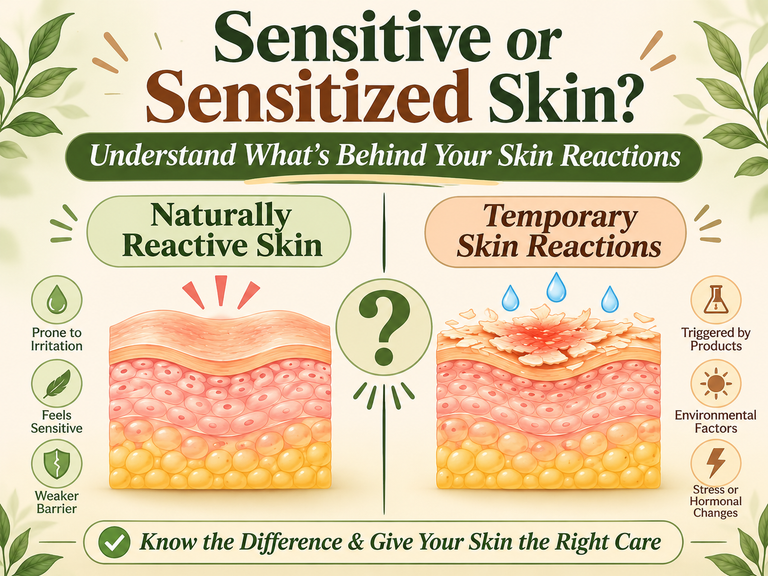
- Reactive vs temporarily irritated: Reactive skin is a recurring tendency. Irritation can follow harsh cleansing, over-exfoliation, or new products.
- Combination vs. facial-zone differences: Mild differences between areas are normal. Combination skin is a more consistent pattern.
| Dry skin | Dehydrated skin | |
| What it refers to | Often lower oil production | Low water in the outer skin layers |
| Duration | Usually a longer-term tendency | Often temporary and condition-based |
| Possible causes | Genetics, age, hormones | Dry air, harsh cleansing, sun, heat |
| Can occur with oily skin? | Not usually | Yes |
| Can it be confirmed by appearance alone? | No | No |
| Looks like | Possible skin type | Possible temporary condition |
| Tight right after washing | Dry skin | A harsh cleanser, hot water |
| Shiny forehead only in summer | Combination skin | Heat and sweat |
| Redness and stinging | Reactive skin | Over-exfoliation, new product, wind |
| Flaking in winter only | Dry skin | Low humidity, indoor heating |
Key takeaway: Ask whether a feature is persistent (same across seasons and routines) or conditional (appears under specific circumstances).
A Practical Method to Observe Skin Across Conditions
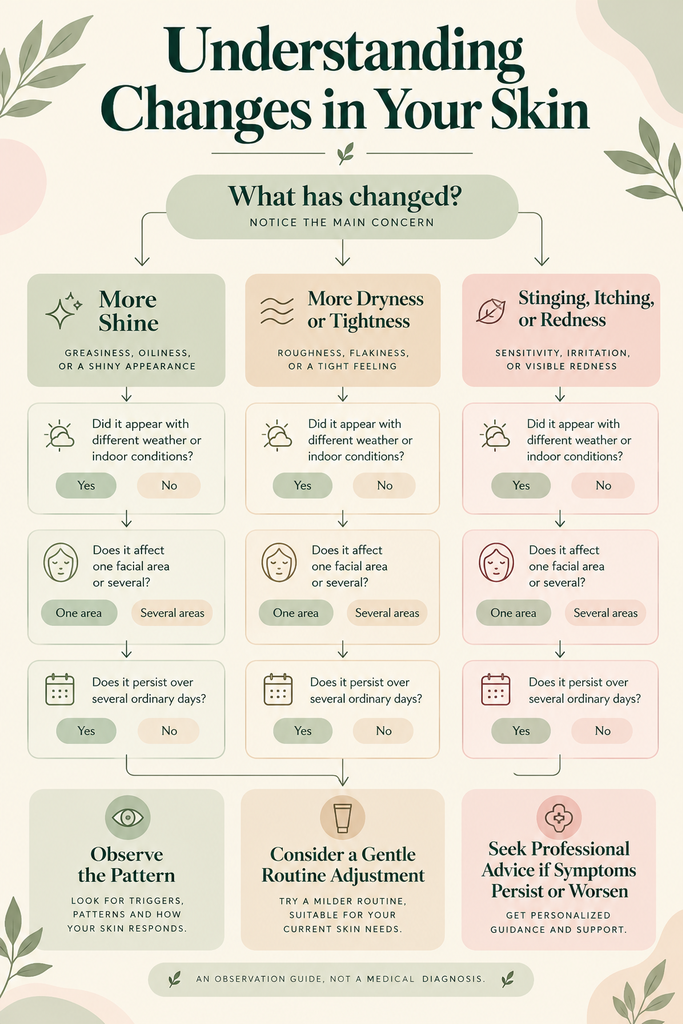
You need no special tools, just a notebook or notes app.
- Observe your skin during an ordinary, comfortable routine.
- Look at the forehead, nose, chin, and cheeks separately.
- Note shine, tightness, roughness, flaking, stinging, or redness.
- Record conditions: hot or cold weather, dry indoor air, or a routine change.
- Compare several ordinary days, not one moment.
- Repeat when the season changes, without deliberately exposing skin to uncomfortable conditions.
Sample observation log:
| Date | Weather or indoor conditions | Facial area | Shine or oiliness | Dryness or tightness | Irritation | Recent routine changes |
| Jan 12 | Heated room, cold outside | Cheeks | None | Mild tightness | None | None |
| Jan 12 | Heated room, cold outside | Forehead | Slight | None | None | None |
| Jul 5 | Hot, humid | Nose | High | None | None | New sunscreen |
Key takeaway: This log is a self-observation aid, not a clinically validated diagnostic test. If a product stings or burns, stop using it. And never stop medically necessary skincare without asking your clinician.
How to Adjust Basic Skincare as Conditions Change
This is general educational guidance, not a product recommendation. Individual tolerance varies.
- Cleanse gently, not excessively. Over-washing can leave skin feeling tight, whatever your type.
- Moisturize according to comfort. Oily skin can still need a light moisturizer. Dry skin doesn’t automatically need many products.
- Use sun protection. Dermatology bodies generally advise sun protection year-round. Check current guidance for details.
- Hold back on exfoliation when skin is irritated. The AAD notes that many dermatologists suggest using products with glycolic acid, salicylic acid, or retinol less often or at lower concentrations in winter.
- Change gradually. One adjustment at a time lets you see what helps.
- Watch each facial zone. Cheeks and T-zone may need different attention.
Climate-specific ideas:
- Cold, dry: The AAD suggests moisturizing right after washing and keeping showers to 5–10 minutes with lukewarm water. Covering skin outdoors can help.
- Hot, humid: A lighter feel may be more comfortable. Rinse sweat away gently.
- Hot, dry: Pay attention to sun protection and avoid prolonged hot water.
- Air-conditioned: If skin feels drier indoors, notice whether it improves away from the cooled air.
Ingredients: Common ingredients such as glycerin, hyaluronic acid, and ceramides are generally used to attract or hold water or support the barrier, but no ingredient is necessary for everyone, and tolerance varies.
Less Obvious Insights and Practical Strategies
1. The Two-Dimension Method. Rate surface oiliness and comfort/dryness/reactivity separately. A person can be oily and tight, or dry and non-reactive. One label (such as “oily”) cannot describe every aspect of skin behaviour, which is why the same advice doesn’t suit everyone with the same label.
2. The Environment-versus-Baseline Comparison. Learn your baseline: how your skin acts in mild, ordinary conditions. Then compare. For example, one person may have more shine in humid weather and more tightness in dry weather, with a similar baseline in spring. That points to the environment and not a permanent shift.
3. The Facial-Zone Strategy. The forehead, nose, chin, and cheeks may behave differently. Classifying the entire face from one area can mislead you.
4. The One-Change-at-a-Time Strategy. If you change cleanser, moisturizer, and exfoliant at once, you can’t know which affected your skin. Gradual, comfortable adjustments beat rigid rules.
5. The Reassessment Strategy. Reassess after a season change, a move, or a persistent shift in comfort. Don’t rework your routine for every minor daily fluctuation.
6. The Irritation Check. Burning, stinging, itching, or persistent redness shouldn’t automatically be written off as “seasonal” or accepted as your skin type. Reviews note that cold and low humidity can make skin more reactive, but persistent irritation can have other causes, including products or a skin condition.
These are practical frameworks built from the science above. They are informal aids, not validated tests.
Common Mistakes to Avoid
- Assuming skin type never changes. Hormones and age can shift it. Instead: reassess periodically.
- Treating every seasonal change as permanent. Instead: check whether it returns to baseline.
- Confusing sweat with sebum. Instead: note if shine appears only with heat or activity.
- Confusing dryness with dehydration. Instead: consider oil and water separately.
- Assuming oily skin can’t be dehydrated. Instead: look for tightness alongside shine.
- Ignoring humidity and indoor climate. Instead, consider heated or air-conditioned rooms.
- Blaming all redness or irritation on weather. Instead: review products and habits, and seek advice if they persist.
- Changing multiple products at once. Instead: change one thing at a time.
- Over-washing or over-exfoliating oily-feeling skin. Instead: cleanse gently.
- Ignoring facial-zone differences. Instead: observe each area.
- Assuming age alone determines skin type. Instead: consider hormones, genetics, and environment.
- Assuming a home log can diagnose a skin disease. Instead: use it for observation only.
When to Seek Professional Advice
Consider seeing a qualified healthcare professional or dermatologist if you notice persistent redness, burning, itching, painful inflammation, significant peeling, or a sudden unexplained change that doesn’t improve with gentle care. The AAD advises seeing a board-certified dermatologist if dry skin continues after trying home measures.
Home observations can’t diagnose eczema, rosacea, allergic contact dermatitis, or other medical conditions. Seeking advice is a sensible step, not a cause for alarm.
Frequently Asked Questions
1. Can your skin type change with age?
It can. Sebum production tends to rise at puberty and may decline later, especially after menopause in women. But changes vary widely, and many people notice few shifts.
2. Can skin type change with the seasons?
How skin feels often changes with the seasons. Your underlying tendency usually stays similar.
3. Why does my skin feel oily in summer but dry in winter?
Heat, sweat, and humidity can add shine in summer. Cold air, low humidity, and indoor heating can reduce water in the outer skin layers in winter. Both can happen to the same person.
4. Can humid weather make skin look oilier?
It can look shinier because of sweat and a damp surface, but that is not necessarily more sebum production.
5. Does cold weather make everyone’s skin dry?
No. Research shows average seasonal changes in the barrier, but individual responses vary, and results differ by body area.
6. Can oily skin also be dehydrated?
Yes. Oil and water content are separate, so skin can be shiny and tight at once.
7. How can I tell whether my skin change is temporary?
Notice whether it follows a condition (weather, heating, a new product) and fades when that condition changes. A log over several ordinary days helps.
8. How often should I reassess my skin?
Roughly at season changes, after a big environmental change, or when a shift persists. Not daily.
9. Should I change my entire routine with every season?
Usually not. Small, gradual adjustments (such as moisturizer feel, shower temperature, or exfoliation frequency) are often enough.
10. When should I seek professional advice about a skin change?
When symptoms such as burning, itching, redness, or peeling persist or worsen, or a sudden change doesn’t improve with gentle care.
Conclusion
Skin is shaped by biology and environment together. Hormones, age, and genetics influence your baseline. Weather, humidity, and indoor air influence how your skin feels from week to week. A temporary change in comfort doesn’t automatically mean your skin type has changed.
Observe patterns over several ordinary days, separate oiliness from moisture-related discomfort, consider your surroundings, and adjust one small thing at a time. Skin that is understood across conditions is easier to care for than skin that is labelled once and forgotten.